About the Bechdel test
A film passes if it has at least two women in it, who talk to each other, about something besides a man.
Where it comes from
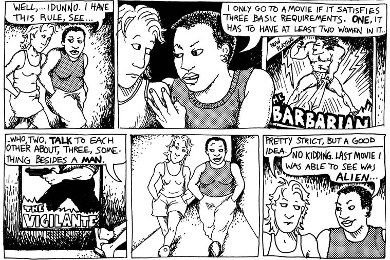
The test comes from Alison Bechdel's 1985 comic strip Dykes to Watch Out For, in the strip called The Rule. One character explains that she only watches movies that meet three requirements. Bechdel credits the idea to her friend Liz Wallace, who was inspired by Virginia Woolf's essay A Room of One's Own (1929).
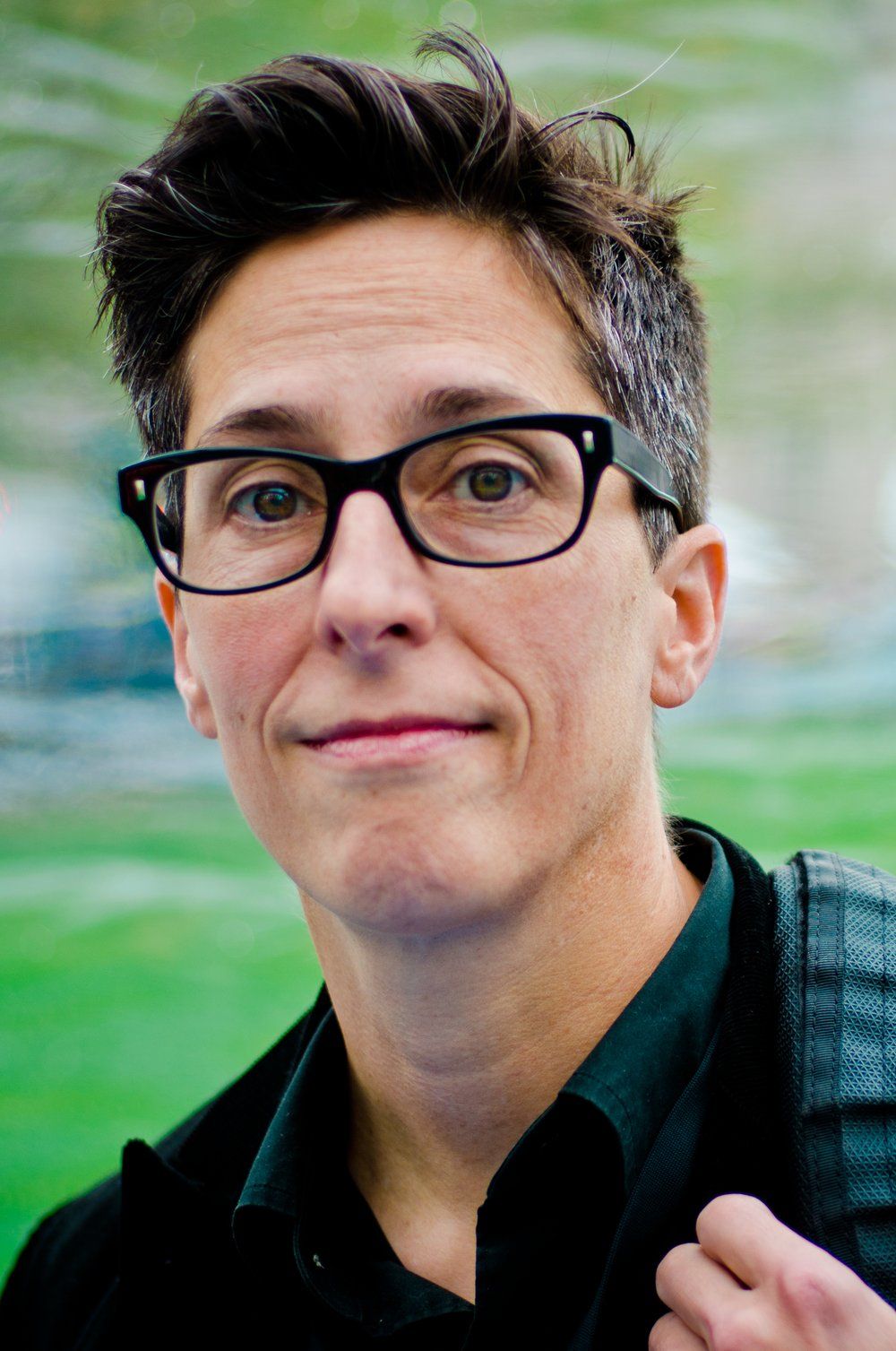
What began as a joke in an independent comic became one of the best-known measures of how films represent women. It took off in the 2010s, when Swedish cinemas began using it to rate films and the press started tracking how Hollywood did. By showing how few films have even one conversation between women about something other than a man, it became a tool for feminist film criticism.
What it can't tell you
The test is simple on purpose, and that's its power. It also means it can't capture everything about how a film treats women.
What it measures
- Whether women have speaking roles
- Whether women talk to each other
- Whether those conversations go beyond men
What it doesn't
- How well the women are written, or how they grow
- Whether they have agency
- Race, class, sexuality and disability
- What the conversation means to the film
- Who made the film: director, writer, cinematographer
A film can pass while leaning on harmful stereotypes, and a film can fail while giving us a powerful woman. Gravity (2013) fails because it has only one woman, yet she carries the whole film. Some films pass on one throwaway line between background characters.
That's why each film page goes past pass or fail: who gets the lines, who's behind the camera, and how old the stars are. bechdeltest.com readers give a second opinion. Use the test to start a conversation, not to end one.
How we check a film
A parser reads the film's script scene by scene. It counts the women and men, finds the scenes where two women speak to each other, and checks whether those scenes name a man. That gives each film its Bechdel score, from 0 to 3. It also counts who speaks, how much, and when, which feeds the rest of each film page.
Scripts are formatted in many ways, so some counts are off. When we can't tell who a line belongs to, or a script didn't parse, the film's page says so.
-
1
The script
We start from the film's shooting script, from the Internet Movie Script Database.
-
2
Scenes
Every scene heading, like INT. THE BAR - DAY, starts a new scene.
-
3
Who's talking
Each line goes to the character who says it. The cast list tells us which characters are women.
-
4
The three rules, in order
- Two women?
- Talking to each other in a scene?
- With no man named?
Each rule met adds a point. A film that fails one rule isn't checked against the next.
Bechdel score, 0 to 3
A second opinion
bechdeltest.com readers rate the film too, so you can see where they agree with us.
The counts
Who gets the lines and the words, how often two women or two men talk, and who worked behind the camera.
The film
Posters, cast, plot, ratings and awards come from TMDB and OMDb.
Artist statement
Bechdel.io checks movie scripts against the Bechdel Test. The test comes from a 1985 Alison Bechdel comic strip, and it asks three things: are there at least two women, do they talk to each other, and do they talk about something other than a man.
It sorts a wall of movies most people have already seen into pass and fail. About half of the 218 films on the shelf fail, and a lot of them are favorites.
We released it as open source because we saw it as feminist activism.
Joe Karlsson, with Laurel Karlsson. The statement is also on bechdel.io’s page on joekarlsson.com.
Why we built it
This digital humanities project, by Joe and me, comes from a shared love of film, feminism and what technology can do. It brings together my work as an English scholar and Joe's as a software engineer.
It started when I asked Joe for advice on a few ideas for a digital humanities project. I wanted to do something with feminist film analysis, but my lack of coding experience held me back, and I couldn't find a data mining tool that did what I needed. Joe offered to build one from scratch. After brainstorming several ideas, we settled on this one.
We also chose it because so few digital humanities projects look at film. Data mining tools are often used on literature and other texts, but rarely on film. Anyone can sit through a film with a notebook and pencil to see if it passes the Bechdel test, but it's slow. Automating it means we can look at a director's whole filmography, an actress's body of work, or every film from one year.
It was an experiment in collaboration, too. We built it without ever sharing a room: I was in Boulder, Colorado, and Joe was in Honolulu, Hawaii. We relied on FaceTime, iMessage and Google Docs, and it worked.
We see this tool as a form of feminist activism, so it's open source and free for anyone to use. The code is on GitHub.
Laurel and Joe
P.S. If you have ideas for where this should go next, we'd love to hear them.
Read more
- The Rule, the 1985 strip where the test began, on Alison Bechdel's site
- Alison Bechdel, her books and comics
- Bechdel Test Movie List, readers rating thousands of films against the test
- The Bechdel test on Wikipedia, its history, variants and critics
- A Room of One's Own, Virginia Woolf's 1929 essay behind the idea
- The Bechdel Test for Women in Movies, a short video from Feminist Frequency
- Visualizing and Analyzing the Hollywood Screenplay with ScripThreads, Digital Humanities Quarterly
Thanks
Thank you to:
- The Bechdel Test Movie List and its readers, whose ratings are the second opinion on every film page
- The Internet Movie Script Database, where the scripts come from, gathered with movie-script-scraper
- The Movie Database (TMDB), for posters, backdrops and cast lists
- The Open Movie Database (OMDb), for plots, ratings and awards
- Chase Elliott Clark, for the photo of Alison Bechdel
 This product uses the TMDB API but is not endorsed or certified by TMDB.