Passes the Bechdel test
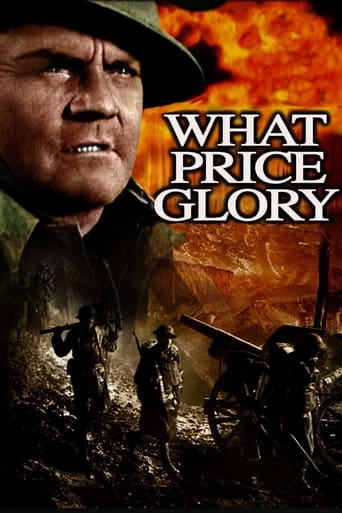
What Price Glory
1952. Directed by John Ford, written by Phoebe Ephron, Henry Ephron, and Maxwell Anderson.
The Bechdel test
What Price Glory (1952) passes the Bechdel test with a score of 3 out of 3. Checked .
Bechdel score
3 / 3
Passes
-
Yes
1. At least two women
3 women in the cast, and 3 women with lines in the script. -
Yes
2. Who talk to each other
In 1 scene out of 85. -
Yes
3. About something besides a man
In that scene, our script parser found no man named. See the scene.
Second opinion
Not rated bechdeltest.com readers haven't rated this film.
The film
In 1918 France, Captain Flagg commands a disreputable company of Marines; his new top sergeant is his old friendly enemy, Quirt. The two men become rivals for the favors of fair innkeeper's daughter Charmaine, but the rivalry goes into reverse when Charmaine proves to be angling for a husband. When the company is ordered to the front, this comedy interlude gives way to the grim realities of war.
- Released
- 28 Jan 1953
- Directed by
- John Ford
- Rated
- Approved
- IMDb
- 6.1 / 10
- Elsewhere
- View on IMDb
Starring, by lines spoken
- Women
- Men
- Not in the cast list
- Bigger name, more lines
- Flagg 294 lines, man (James Cagney)
- Quirt 162 lines, man (Dan Dailey)
- Charmaine 53 lines, woman (Corinne Calvet)
- Kiper 48 lines, man (William Demarest)
- Lewisohn 37 lines, man (Robert Wagner)
- Pete 28 lines, man (Henri Letondal)
- Aldrich 26 lines, man (Craig Hill)
- Moran 19 lines, man (Harry Morgan)
- Lipinsky 18 lines, man (Wally Vernon)
- Nicole 17 lines, woman (Marisa Pavan)
Full cast, 56 people
- James Cagney as Captain Flagg
- Corinne Calvet as Charmaine
- Dan Dailey as Sergeant Quirt
- William Demarest as Corporal Kiper
- Craig Hill as Lieutenant Aldrich
- Robert Wagner as Private Lewisohn
- Marisa Pavan as Nicole Bouchard
- Max Showalter as Lieutenant Moore
- James Gleason as General Cokely
- Wally Vernon as Lipinsky
- Henri Letondal as Cognac Pete
- Harry Morgan as Sergeant Moran (uncredited)
- Paul Fix as Gowdy (uncredited)
- Torben Meyer as Mayor (uncredited)
- Danny Borzage as Gilbert (uncredited)
- William Henry as Holsen (uncredited)
- Ray Hyke as Mulcany (uncredited)
- Jack Pennick as Ferguson (uncredited)
- Louis Mercier as Bouchard (uncredited)
- Sean McClory as Lt. Austin (uncredited)
- Scott Forbes as Lt. Bennett (uncredited)
- Stan Johnson as Lt. Cunningham (uncredited)
- Fred Libby as Lt. Schmidt (uncredited)
- Tom Tyler as Capt. Davis (uncredited)
- Charles B. Fitzsimons as Capt. Wickham (uncredited)
- Luis Alberni as Grand Uncle (uncredited)
- Olga Andre as Sister Clothilde (uncredited)
- George Bruggeman as German Lieutenant (uncredited)
- Frederic Brunn as German Officer (uncredited)
- Paul Bryar as Charmaine's Uncle (uncredited)
- John Caler as Young Marine (uncredited)
- Harry Carter as Runner (uncredited)
- Ann Codee as Nun (uncredited)
- George Davis as Uncle (uncredited)
- Michael Dugan as Aide General (uncredited)
- Arno Frey as German Officer (uncredited)
- Don Garner as Young Marine (uncredited)
- Louis J. Gasnier as Brother (uncredited)
- Steve Hayes as Soldier (uncredited)
- Billy Jones as Young Marine (uncredited)
- Fred Kennedy as Young Marine (uncredited)
- Henry Kulky as Company Cook (uncredited)
- Arlyn E. Loynd as Marine Recruit (uncredited)
- Lee MacGregor as Young Marine (uncredited)
- Wayne Mallory as Runner (uncredited)
- Richard Monahan as Young Marine (uncredited)
- Barry Norton as Priest (uncredited)
- James O'Hara as Young Soldier (uncredited)
- Peter Ortiz as French General (uncredited)
- Bill Scully as Marine (uncredited)
- Richard Shackleton as Marine Recruit (uncredited)
- Mickey Simpson as Military Policeman (uncredited)
- Harry Tenbrook as Laughing Marine (uncredited)
- Kenny Williams as Young Marine (uncredited)
- William Yetter Sr. as German Officer (uncredited)
- Alfred Zeisler as German Colonel (uncredited)
Who talks, scene by scene
Lines of dialogue in groups of 2 scenes, start to finish. Women above the line, men below. 5% of lines come from characters we couldn't match to the cast list and aren't shown.
Women
Men
Scene 1 Scene 85
Hover, tap or tab to a bar (then use the arrow keys) to see those scenes: where they happen and who's talking.
Show the numbers
| Scenes | Women's lines | Men's lines |
|---|---|---|
| 1 to 2 | 0 | 15 |
| 3 to 4 | 1 | 15 |
| 5 to 6 | 0 | 1 |
| 7 to 8 | 0 | 0 |
| 9 to 10 | 0 | 4 |
| 11 to 12 | 1 | 4 |
| 13 to 14 | 0 | 15 |
| 15 to 16 | 0 | 19 |
| 17 to 18 | 8 | 18 |
| 19 to 20 | 3 | 2 |
| 21 to 22 | 2 | 33 |
| 23 to 24 | 6 | 56 |
| 25 to 26 | 0 | 1 |
| 27 to 28 | 0 | 1 |
| 29 to 30 | 0 | 24 |
| 31 to 32 | 0 | 5 |
| 33 to 34 | 6 | 6 |
| 35 to 36 | 8 | 7 |
| 37 to 38 | 0 | 81 |
| 39 to 40 | 0 | 3 |
| 41 to 42 | 0 | 7 |
| 43 to 44 | 5 | 62 |
| 45 to 46 | 2 | 1 |
| 47 to 48 | 1 | 25 |
| 49 to 50 | 0 | 40 |
| 51 to 52 | 0 | 15 |
| 53 to 54 | 0 | 15 |
| 55 to 56 | 0 | 6 |
| 57 to 58 | 0 | 1 |
| 59 to 60 | 0 | 2 |
| 61 to 62 | 0 | 3 |
| 63 to 64 | 0 | 0 |
| 65 to 66 | 0 | 7 |
| 67 to 68 | 0 | 2 |
| 69 to 70 | 0 | 16 |
| 71 to 72 | 0 | 39 |
| 73 to 74 | 0 | 19 |
| 75 to 76 | 27 | 105 |
| 77 to 78 | 0 | 17 |
| 79 to 80 | 1 | 14 |
| 81 to 82 | 3 | 5 |
| 83 to 84 | 0 | 0 |
| 85 to 85 | 1 | 1 |
The evidence
- Straight from the script
- Counted from the script, the credits
Tap an exhibit's title to open it.
Exhibit A: the passing scene
The scene our parser counted as passing, word for word.
E CHARMAINE: Je ne comprends pas. CHARMAINE: Pauvre petit! There were no other women! i ,
Exhibit B: every 100 lines
Out of every 100 lines with a known speaker, 10 are women's.
75 lines from women, 712 from men.
- Women
- Men
Exhibit C: who's in it
3 women and 45 men in the cast. In the script, 3 women and 23 men get lines.
Characters
With lines
- Women
- Men
Exhibit D: who gets heard
The first woman speaks at line 28 of 830. The longest stretch with no woman speaking runs 194 lines.
Every line of dialogue, first to last
- First line by a woman
- Longest stretch with no woman speaking
Words spoken
Women speak 6% of the words (530), men 94% (8,616). Women have 10% of the lines, so their lines run shorter than men's.
Exhibit E: first and last word
A man opens the film and a woman closes it. The first is a lead, the last a side character.
Flagg: Not Bar-le-Duc, Kiper... Bar-le-Duc. And that's where we're going.
Man, a lead, most lines (294)
Charmaine: Oui. Ils sont partis.
Woman, side character, 3rd-most lines (53)
From the script, which can differ from the film as released. A lead is one of the two characters with the most lines. Across the shelf, 32% of films end on a woman's line.
Exhibit F: the test the other way
Two named men talk to each other about something besides a woman. It passes the reverse test.
Conversations between two named characters
Two women
1
Two men
60
Exhibit G: behind the camera
2 of the 8 people in these jobs are women. Across the whole crew, 13% of the people whose gender is listed are women.
- Directed by
- John Ford (man)
- Written by
- Phoebe Ephron (woman), Henry Ephron (man)
- Produced by
- Sol C. Siegel (man)
- Shot by
- Joseph MacDonald (man)
- Edited by
- Dorothy Spencer (woman)
- Music by
- Alfred Newman (man)
- Costumes by
- Edward Stevenson (man)
The crew, department by department
-
Art
0 women, 4 men
-
Writing
1 woman, 3 men
-
Costume & Make-Up
0 women, 2 men
-
Camera
0 women, 1 man
-
Directing
0 women, 1 man
-
Editing
1 woman, 0 men
-
Production
0 women, 1 man
-
Sound
0 women, 1 man
- Women
- Men
- Gender not listed on TMDB
Exhibit H: how old the stars were
Women: 24 on average. Men: 44 on average. The top-billed cast, at the film's release.
Women
Marisa Pavan 20, Corinne Calvet 27
Men
Robert Wagner 22, Craig Hill 26, Max Showalter 35, Dan Dailey 36, Wally Vernon 47, James Cagney 53, William Demarest 60, James Gleason 70
About this analysis
Our parser read the script: 85 scenes and 830 lines of dialogue. How the test works